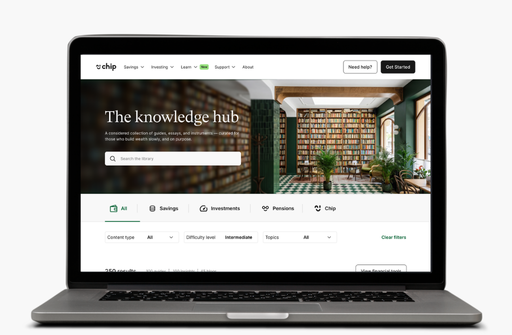
The knowledge hub

A considered collection of guides, essays, and instruments — curated for those who build wealth slowly, and on purpose.

0
results
Filter results
Filter by:
Content type
Difficulty level
Topics
0
results
View financial tools
Your ISA deposit deadlines for the 2025/2026 tax year
2 min read
Rates, Tax & Economics

The 2025/26 tax year ends at midnight on 5 April 2026 and your annual ISA allowance will reset for a new tax year.

If you have any ISA allowance remaining (you can check this in your app) and want to make a deposit within the 2025/26 tax year, here’s the deadlines you need to know.

Deposit before:

  • 23:00 on Tuesday 31 March 2026 — Stocks & Shares ISA
  • 23:00 on Thursday 2 April 2026 — Smart Cash ISA  

Deposits that successfully make it into your Chip ISAs before these deadlines will count towards your 2025/2026 ISA allowance.

Any further deposits into your Cash ISA beyond these deadlines, may still successfully land in your balance, but we can’t guarantee it. Successful deposits made before 23:59 on Sunday 5 April will count towards your 2025/2026 ISA allowance.

But please note that there can be unexpected delays, often caused by banks limiting deposits out and circumstances outside of our control. Your deposit is only valid when it reaches our banking partner—see more below.  

Next year will be the last year you can use your full allowance in cash

In the 2025 Autumn budget the government announced that 2026/27 will be the last year where you put your full £20,000 annual ISA allowance into cash.

From April 2027 onwards you will only be able to put £12,000 of your total £20,000 annual allowance into cash (unless you’re over 65).

So, bear in mind if you do like to put your full allowance into cash, you’ve only got one more year to fill it up.

Best ways to deposit

Our most popular option for transferring into your ISA is through connected bank transfer. Simply follow the instructions in the app to connect to your provider.

You can also make a manual bank transfer into your Cash ISA, which is best used for making deposits over £5,000.

In most cases, for both of these methods, your money arrives in seconds, but it can take up to two hours.

Looking to transfer from another ISA?

You can easily transfer an ISA from another provider into Chip’s Cash or Stocks & Shares ISA.

Transfers don’t affect your annual £20,000 ISA allowance, as your allowance applies to new money only, so you don’t need to factor this in regard to the end of the tax year. You’re free to initiate a transfer anytime you like.

Make sure you check our list of approved Cash ISA providers we accept transfers from.

Unfortunately, we are unable to accept transfers from providers not on this list at the moment, but we are adding more all the time.

Having trouble depositing?

If this is your first ISA deposit, we’ve found our members have the most success making a first deposit of less than £1,000.

Keep in mind that your bank may limit daily transactions on transferring money from your current account to your ISA.

These limits can vary drastically between providers, so check with your bank if you’re looking to move larger amounts.

You may have also set your personal limits on daily transfers, so adjust these accordingly if you haven’t already.

There may also be additional security checks on larger transactions, so factor this in and try and plan ahead.

“I’m lost, what’s an ISA?”

ISAs are tax-efficient savings and investment accounts that offer tax-efficient exemptions on interest and returns earned within the account.

However, you are limited to depositing £20,000 within a given tax year (which runs April to April). This is your ‘annual ISA allowance’ and it is available on a use it or lose it basis.

You can learn more about ISAs in our quick guide here.

It’s simple with Chip

Navigating ISAs is easy with Chip. You can have a Cash ISA, Stocks & Shares ISA or both; all accessible in one easy-to-use app.

Our flexible Smart Cash ISA allows you to make unlimited withdrawals and deposits without affecting your £20,000 allowance. Providing penalty-free access to your funds, whenever you need them, with all the tax advantages.

Our Stocks & Shares ISA allows you to effortlessly set up recurring deposits, which are then invested directly into the funds you've selected. This ensures your money is consistently working for you in your chosen investments to build wealth tax-free.

Pension funds
2 min read
Intermediate
Building your pension

What is a pension fund? 

A pension fund is a large pot of money pooled together from many different pension savers. Professional fund managers use this pool to buy a diverse range of assets within their pension plans, such as:

  • Shares: (equities): Owning small parts of companies (e.g. Apple, Shell, Tesco). Historically, these offer high growth but come with higher volatility. 
  • Bonds: Loaning money to governments or corporations in exchange for interest. These are generally safer/lower risk but offer lower returns.
  • Property: Commercial real estate like warehouses and office blocks.

By investing in a fund, you don’t choose specific investments yourself. The aim of holding a fund is to spread your risk over hundreds or even thousands of assets, to smooth out the ups and downs of the market.

What is a target date fund? 

A target date fund (TDF) is a type of pension fund designed to make retirement planning simple and automatic.

Instead of asking you to choose a level of risk when you start pension saving, you simply enter the year you plan to retire.

  • In the early years (when retirement is far away) the fund automatically invests mostly in shares to maximise growth. You can afford to take risks because you have time to recover from market dips.
  • In the later years (as you approach retirement) the fund gradually shifts your money into safer assets like bonds. This protects your pot from volatility as you get closer to needing the money.

The ‘glide path’ approach removes the need for you to constantly monitor and rebalance your portfolio, as the fund does this for you.

Choosing a pension fund 

If you are managing your own pension (like in a SIPP) or looking at your workplace options, choosing the ‘right’ fund depends on your timeline.

  • Timeframe: If you have 30+ years until retirement, inflation could erode the returns from lower risk assets, so some exposure to shares can help beat rising prices. If you’re retiring next year, you’ll likely want the safety from cash or bonds. 
  • Risk tolerance: Think about the risk you’re comfortable with. Can you handle watching some ups and downs as the market moves? If not, a lower-risk fund might be better suited to you, even if returns are lower.

What is a default pension fund?

A default pension fund is the investment option you’re automatically allocated when you join a workplace pension scheme. It’s a ‘one-size-fits-all’ solution for the average employee.

While default funds are regulated to be suitable for most people, they are not tailored to your specific circumstances or retirement savings trajectory.

They typically take a balanced approach that’s potentially too cautious for the younger saver or too risky for someone closer to retirement.

Some default funds use a target date approach and adjust automatically, check whether yours does. 

How to check your pension fund  

To check which pension fund you’re invested in and how it's performing:

  1. Log in to your provider’s app or website
  2. Find your fund ‘factsheet’. This document will give you a breakdown of what the fund is invested in, along with past performance and the risk profile.
  3. Check your fees: Look for the Ongoing Charge Figure (OCF) or Annual Management Charge (AMC). Just as investment returns compound over time, so do the costs of high fees, making them more damaging than they might initially appear.  

Pension consolidation

Understanding where your pension savings are invested is crucial, but this can be very difficult to track if you have a lot of different pots from previous jobs; some of which you may have difficulty accessing.

Managing a portfolio of scattered funds can mean you’re paying higher fees, losing track of documentation, and lacking a clear strategy. One solution to this may be  to consolidate; bringing your pensions to one provider that gives you complete oversight over how much you have and where it’s invested.


Note: Before consolidating, check whether any of your existing pots have valuable guarantees, such as a guaranteed annuity rate, that would be lost on transfer. Read our next guide to learn more.

Important limitation: The Chip SIPP does not currently offer a drawdown service. To access your funds at retirement, you will need to transfer your pension to a provider that supports drawdown.

Biggest companies in China by market cap
2 min read
Expert
Global cap giants

What are the biggest companies in China by market cap?

This list ranks China’s biggest public companies by market capitalisation; the cumulative value of a company's total outstanding market shares. We’ll also be highlighting other key figures, such as the company's revenue, gross profit, and 1-year return (all based on the previous fiscal year). 

Some other key facts such as the exchange the company is listed on, the founding year and country the company is headquartered in are also covered.

1. Industrial and Commercial Bank of China (ICBC)

  • Market cap: $349 billion
  • Revenue: $221 billion
  • Gross profit: N/A 
  • 1-yr return: +34.6%
  • Exchange: SSE
  • Year founded: 1984
  • Country: China

ICBC is the world's largest bank by total assets. As one of China's "Big Four" state-owned commercial banks, it provides a comprehensive range of financial services to a massive customer base.

  • Corporate banking: Offers financial services to corporations, government agencies, and financial institutions, including loans, trade financing, and asset management.
  • Personal banking: Provides a full suite of services to individuals, including deposits, loans, credit cards, and wealth management.

2. Agricultural Bank of China (AgBank)

  • Market cap: $338 billion
  • Revenue: $193 billion
  • Gross profit: N/A
  • 1-yr return: +55.36%
  • Exchange: SSE
  • Year founded: 1951
  • Country: China

Another of the "Big Four" state-owned banks, AgBank was initially established to serve China's vast rural population but has since expanded into a major commercial bank.

  • Sannong banking: A core focus on providing financial services to the agriculture, rural areas, and farmer demographics.
  • Corporate & personal banking: Offers a wide range of standard banking services to both corporate and individual clients.

3. China Construction Bank Corp. (CCB)

  • Market cap: $267 billion
  • Revenue: N/A
  • Gross profit: N/A
  • 1-yr return: +27.48%
  • Exchange: SSE
  • Year founded: 1954
  • Country: China

CCB is one of the "Big Four" state-owned banks in China and is a market leader in infrastructure loans.

  • Infrastructure lending: A primary focus on providing long-term credit for major infrastructure projects like transportation and energy.
  • Corporate & personal banking: Offers comprehensive financial services, including corporate finance, personal banking, and treasury operations.

4. Kweichow Moutai Co.

  • Market cap: $265 billion
  • Revenue: $21.7 billion
  • Gross profit: $19.5 billion
  • 1-yr return: +12.17%
  • Exchange: SSE
  • Year founded: 1999
  • Country: China

Kweichow Moutai is the world's most valuable liquor company, famous for producing Moutai baijiu, a prestigious and fiery spirit that is considered China's national liquor.

  • Moutai Baijiu: Production of its high-end baijiu, a spirit distilled from fermented sorghum, which is a staple at state banquets and a popular luxury gift.

5. China Mobile Limited

  • Market cap: $245 billion
  • Revenue: $146 billion
  • Gross profit: $38.1 billion
  • 1-yr return: +8.04%
  • Exchange: SSE
  • Year founded: 1997
  • Country: China

China Mobile is the world's largest mobile network operator by number of subscribers, providing telecommunications and mobile services to a vast domestic market.

  • Mobile voice & data: Its core business involves providing mobile and 5G services to over 900 million subscribers.
  • Broadband & digital services: Offers wireline broadband and a range of digital services for both personal and corporate customers.

6. Contemporary Amperex Technology (CATL)

  • Market cap: $228 billion
  • Revenue: $52.3 billion
  • Gross profit: $12 billion
  • 1-yr return: +99.65%
  • Exchange: SZSE
  • Year founded: 2011
  • Country: China

CATL is the world's largest manufacturer of electric vehicle (EV) batteries, supplying a huge portion of the global automotive industry.

  • EV battery systems: Designs and manufactures rechargeable lithium-ion batteries for electric vehicles for major clients like Tesla, BMW, and Volkswagen.
  • Energy storage systems: Develops large-scale battery systems for storing energy from renewable sources like solar and wind.

7. PetroChina Co. Ltd.

  • Market cap: $217 billion
  • Revenue: N/A
  • Gross profit: N/A
  • 1-yr return: +7.36%
  • Exchange: SSE
  • Year founded: 1999
  • Country: China

PetroChina is China's largest oil and gas producer and distributor, playing a pivotal role in the country's energy sector.

  • Exploration & production: Manages the exploration, development, and production of crude oil and natural gas.
  • Refining & chemicals: Operates refineries and chemical plants to process crude oil into a wide range of petroleum and chemical products.

8. Bank of China Ltd.

  • Market cap: $175 billion
  • Revenue: $86.50 billion
  • Gross profit: N/A
  • 1-yr return: +16.13%
  • Exchange: SSE
  • Year founded: 1912
  • Country: China

The fourth of the "Big Four" state-owned banks, the Bank of China is the most international and diversified of the group.

  • International banking: Has a significant global presence, specializing in foreign exchange and international trade finance.
  • Corporate & personal banking: Provides a full range of financial services to clients both in mainland China and abroad.

9. Foxconn Industrial Internet Co.

  • Market cap: $166 billion
  • Revenue: $99 billion
  • Gross profit: $6.8 billion
  • 1-yr return: +224.07%
  • Exchange: SSE
  • Year founded: 2015
  • Country: China

A subsidiary of the Taiwanese giant Hon Hai Precision Industry (Foxconn), Fii focuses on the more advanced aspects of electronics manufacturing.

  • High-performance computing: Manufactures cloud servers, data centers, and industrial AI solutions.
  • 5G & IoT: A key producer of communications network equipment and Internet of Things (IoT) devices.

10. China Merchants Bank Co.

  • Market cap: $149 billion
  • Revenue: N/A
  • Gross profit: N/A
  • 1-yr return: +37.91%
  • Exchange: SSE
  • Year founded: 1987
  • Country: China

China Merchants Bank is China's largest non-state-owned bank and is widely regarded as a leader in the country's retail and private banking sectors.

  • Retail banking: A major focus on serving individual customers, particularly affluent clients, with a strong reputation for its credit card and wealth management services.
  • Corporate banking: Provides a range of services to corporate clients, though it is best known for its retail operations.

What are the biggest companies by total annual revenue?

  • PetroChina Co.: $431.66 billion 
  • Sinopec Corp.: $425.11 billion 
  • China State Construction Engineering: $305.88 billion 
  • China Mobile Limited: $145.74 billion 
  • Industrial and Commercial Bank of China: $120.33 billion

What are the biggest companies by workforce?

  • BYD Company: 968,870 
  • China Mobile Limited: 455,400 
  • Agricultural Bank of China: 454,720 
  • Industrial and Commercial Bank of China: 415,160 
  • China Construction Bank: 376,850

Summary

Understanding a company's performance is crucial; it's how you truly know what you own. These metrics directly drive the value of your stocks and funds. When you understand these key drivers, you can navigate market changes with confidence, rather than just reacting to headlines.

Next we’ll be looking at the biggest companies in South America by market cap.

All market data sourced from TradingView and company reports as of 17.09.2025.

January money check-in
2 min read
Accounts & Products

January is where all those “I’ll sort it next year” moments and prior good intentions are suddenly in the present.

That’s why this month at Chip we’re focusing on simple ways to get control of our money and feel a bit more organised.

Last week, we looked at savings challenges, with fun, motivating ways to build better habits.

This week, we’re tackling the real-life money situations people find themselves in right now. If any of them sound familiar, you’re not alone – and there’s an easy next step.

1. “I haven’t used any of my ISA allowance”

Your ISA allowance resets in April and if it's been quietly sitting there unused, January is a good time to revisit it.

ISAs let your money grow tax-free1, which makes it one of the most valuable tools for long-term saving – yet many people don’t take advantage of them.

Your ISA allowance doesn’t roll over either, so it’s important to use it before you lose it after 5 April.

1Chip does not provide tax advice. Tax treatment depends on individual circumstances and may be subject to change in the future.

How Chip can help:

The Chip Cash ISA gives you a tax-efficient place to hold your savings, while still keeping access when you need it.

You can deposit up to £20,000 per tax year, earn interest tax-free, and stay flexible if plans change. It’s a simple way to make sure more of your money stays yours as your wealth grows.

Pleae note that the Chip Cash ISA is now closed to new customers.

2. “My money is just sitting in my current account”

This is one that many of us are guilty of. In fact, it’s estimated that £526 billion is currently sitting idle in current accounts.

We get it, our salary is paid in, and it can be easy to just leave it there. But If your spare cash sits in your current account earning 0%, it’s likely losing value to inflation when it could be earning interest.

Current accounts are great for day-to-day spending, but not so great for holding onto money you’re not actively using.

How Chip can help:

The Chip Instant Access account lets your money start earning interest straight away, with unlimited withdrawals that arrive in seconds, whenever you need it.

It’s ideal for cash you want to spend in the short-term; so you can use it to top your current account as you go, while you pocket that extra interest.

3. “I’ve got something coming up this year I’m saving for”

A holiday. A wedding. A house move. For a big life moment, January is often when those plans start to feel real – and so does the need to save for them.

But it’s not just about saving. The hard part can be staying on track. This is where ‘unlimited access’ isn’t actually that helpful, and some guard rails can come in handy.

How Chip can help:

The Easy Access Saver is designed for short-to-medium-term goals. With up to three penalty‑free withdrawals a year, it gives you structure without locking your money away; helping you stay focused on what you’re saving for.

It’s a gentle nudge towards consistency, and a simple way to avoid temptation and impulse purchases.

Making it easy to get started:

Whichever situation you’re in, getting your money organised doesn’t need to be complicated. With all Chip savings accounts, you can:

Deposit in just a few taps using seamless Open Banking technology.

Move money instantly between accounts to suit your needs.

Set up automatic recurring deposits, so saving happens before you even think about it.

Less effort, less account admin, just more progress towards your goals. Use Chip to give your money a setup that works for the year ahead, so you can focus on your other resolutions this year.

Biggest companies in India by market cap
2 min read
Expert
Global cap giants

What are the biggest companies in India by market cap?

This list ranks the biggest public companies in the Indian market by market capitalisation. We’ll also highlight other key figures, such as revenue, gross profit, and 1-year return. Key facts like the company's exchange, founding year, and country are also covered.

1. Reliance Industries Ltd. (RELIANCE)

  • Market cap: $209.8 billion
  • Revenue: $108.41 billion
  • Gross profit: $29.94 billion
  • 1-yr return: -10.23%
  • Exchange: NSE
  • Year founded: 1957
  • Country: India

India’s largest and most valuable company, a globally reaching conglomerate with influence spanning energy, tech and consumer services. 

  • Oil-to-chemicals: This is Reliance’s core and most profitable division. It operates the world’s largest single-location oil refinery, and produces everything from transportation fuel to plastics, providing huge streams of cashflow to other areas of the business. 
  • Reliance Retail: India’s largest retailer with over 18,000 stores across the country, supplying its customers with groceries, electronics and fashion.
  • Jio Platforms (digital services): The largest mobile network operator in India with over 450 million subscribers, offering telecoms, streaming services (JioCinema), payment apps, and other online services. 

2. HDFC Bank (HDFCBANK)

  • Market cap: $163.47 billion
  • Revenue: $54.83 billion
  • Gross profit: N/A
  • 1-yr return: +8.76%
  • Exchange: NSE
  • Year founded: 1994
  • Country: India

India’s largest private-sector bank by assets, operating a broad spectrum of banking services with a strong focus on both individual consumers and large corporations. 

  • Retail banking: serves over 80 million customers across India with current and savings accounts, personal, car and business loans, and credit cards. 
  • Wholesale banking: provides medium and large-sized businesses, corporations and institutional clients with capital loans, trade finance, cash management solutions, and investment banking services.
  • HDFC merger: HDFC Bank merged with HDFC Ltd. — India’s largest housing finance company — in 2023. This gave HDFC Bank a massive book of home loans, making it a leader in the mortgage market.

3. Bharti Airtel Ltd. (BHARTIARTL)

  • Market cap: $122.05 billion
  • Revenue: $20.87 billion
  • Gross profit: $8.28 billion
  • 1-yr return: +9.59%
  • Exchange: NSE
  • Year founded: 1995
  • Country: India

One of the world’s leading telecommunications companies, with a significant presence across South Asia and Africa. In the Indian market, Airtel is a key rival of Reliance Jio, in mobile, broadband and digital services. 

  • Airtel India: serves over 300 million subscribers with mobile services, broadband, digital TV and payment services through their ‘Thanks’ app. 
  • Airtel Africa: leading telecom and money provider across 14 countries in Africa, providing mobile and data services, alongside mobile payments that allow users to transfer money, pay bills, and access other financial services. 

4. Tata Consultancy Services Ltd. (TCS)

  • Market cap: $117.99 billion
  • Revenue: $28.81 billion
  • Gross profit: $9.1 billion
  • 1-yr return: -32.62%
  • Exchange: NSE
  • Year founded: 1968
  • Country: India

A huge IT services and consulting company, part of the huge Tata Group multinational conglomerate. They rival big firms like Accenture and IBM as a global tech services leader.

  • IT services and consulting: providing a range of tech solutions to multinational corporations globally, with their cloud infrastructure, cybersecurity, data and analytics and bespoke software development.
  • Business and industry solutions: specialises in tailored industry-specific solutions, particularly within banking and financial services, and insurance — this is their largest source of revenue. They also have clients within retail, manufacturing and healthcare, helping them manage core processes like supply chain and customer relations. 

5. ICICI Bank Ltd. (ICICI)

  • Market cap: $108.28 billion
  • Revenue: $32.98 billion
  • Gross profit: N/A
  • 1-yr return: +4.33%
  • Exchange: NSE
  • Year founded: 1955
  • Country: India

One of India’s largest private-sector banks and a key player in the country’s financial system. A key competitor of HDFC Bank and the State Bank of India.

  • Retail banking: provides millions of customers with current accounts, savings accounts, personal loans, mortgages, and credit cards. It has a strong digital product presence from its iMobile Pay app, that provides a wide array of payment and banking services.
  • Corporate and institutional banking: Provides financial solutions to businesses of all sizes, including working capital finance, and term loans, alongside cash management and trade finance services to aid business operations. 

6. State Bank of India (SBIN)

  • Market cap: $90.5 billion
  • Revenue: $74.06 billion
  • Gross profit: N/A
  • 1-yr return: +8.8%
  • Exchange: NSE
  • Year founded: 1921
  • Country: India

India's largest public-sector bank and a cornerstone of the nation's financial system. With its unparalleled reach across the country, it is a dominant force in both retail and corporate banking.

  • Retail banking: Serves a massive customer base of over 450 million people through an extensive network of more than 22,000 branches. It is a leader in personal banking, offering services from basic savings accounts and home loans to wealth management, and operates the popular YONO digital banking app.
  • Corporate banking and treasury: Acts as the primary banker to many of India's largest corporations and state-owned enterprises, providing project finance, working capital loans, and treasury services. Due to its government ownership, it plays a key role in financing national infrastructure and industrial projects.

7. Bajaj Finance Ltd. (BAJFINANCE)

  • Market cap: $69.45 billion
  • Revenue: $7.75 billion
  • Gross profit: $4.88 billion
  • 1-yr return: +28.96%
  • Exchange: NSE
  • Year founded: 1987
  • Country: India

One of India's largest and most diversified non-banking financial companies (NBFCs). A leader in consumer finance, it is renowned for its rapid growth and use of technology to provide instant loans to millions of customers.

  • Consumer lending: This is the company's core business, offering a vast array of financing options directly to consumers. It is a dominant player in providing instant loans for electronics, home appliances, and furniture at thousands of retail stores, as well as offering personal loans and credit cards.
  • SME and commercial lending: Provides a range of financial solutions to small and medium-sized enterprises (SMEs) and commercial clients, including working capital loans and financing for business expansion. It also has a significant presence in lending to real estate developers. 

8. Infosys Ltd. (INFY)

  • Market cap: $67.31 billion
  • Revenue: $18.34 billion
  • Gross profit: $5.69 billion
  • 1-yr return: -23.31%
  • Exchange: NSE
  • Year founded: 1981
  • Country: India

A global leader in IT services and consulting, and one of the most prominent technology companies to emerge from India. It is a major competitor to other IT giants like TCS, Wipro, and Accenture.

  • Digital services and consulting: Focuses on helping large businesses modernise their technology through "digital transformation." This includes moving clients to the cloud, implementing AI and data analytics solutions, and enhancing cybersecurity.
  • Core enterprise services: Manages the foundational IT operations for its global clients. This involves application development and maintenance, modernising legacy systems, and outsourcing business processes to improve efficiency.

9. Hindustan Unilever Ltd. (HINDUNILVR)

  • Market cap: $66.07 billion
  • Revenue: $7.07 billion
  • Gross profit: $3.16 billion
  • 1-yr return: -15.17%
  • Exchange: NSE
  • Year founded: 1956
  • Country: India

India's largest Fast-Moving Consumer Goods (FMCG) company and a subsidiary of the British multinational, Unilever. Its products are a household staple, reaching nine out of ten Indian homes.

  • Home and personal care: This is HUL's largest division, encompassing a vast portfolio of iconic brands. It includes soaps and skincare (Lifebuoy, Lux, Dove), laundry detergents (Surf Excel, Rin), and surface cleaners (Vim).
  • Foods and refreshment: HUL is a major player in India's food and beverage market. Key brands include Brooke Bond and Lipton teas, Bru coffee, Knorr soups and noodles, and Kwality Wall's ice cream.

10. Life Insurance Corp. of India (LICI)

  • Market cap: $63.7 billion
  • Revenue: $101.18 billion
  • Gross profit: N/A
  • 1-yr return: -11.9%
  • Exchange: NSE
  • Year founded: 1956
  • Country: India

India's largest state-owned life insurer and a dominant force in the country's insurance sector. As a household name, it is one of the biggest institutional investors in the Indian stock market.

  • Insurance and pension plans: This is LIC's core business, offering a vast range of life insurance policies, annuities, and pension plans to millions of individual customers. It operates through an extensive network of over a million agents, giving it enormous reach into both urban and rural India.
  • Investment operations: LIC manages a colossal investment portfolio, making it a cornerstone of the Indian economy. It invests the premiums collected from policyholders into government securities and equities, making it one of the largest single investors in many Indian companies.

What are the biggest companies by total annual revenue?

  • Reliance Industries Ltd.: $108.41 billion 
  • Life Insurance Corp. of India: $101.18 billion 
  • Indian Oil Corp Ltd.: $85.38 billion 
  • State Bank of India: $74.06 billion 
  • Oil & Natural Gas Corp. Ltd.: $69.03 billion

What are the biggest companies by workforce?

  • Tata Consultancy Services Ltd.: 607,980
  • Quess Corp. Ltd.: 441,150 
  • Larsen & Toubro Ltd.: 412,970
  • Infosys Ltd.: 323,580 
  • Petrobras: 236,230

Summary

Understanding a company's performance is crucial; it's how you truly know what you own. These metrics directly drive the value of your stocks and funds. When you understand these key drivers, you can navigate market changes with confidence, rather than just reacting to headlines.

Next we’ll be looking at the biggest companies in Europe by market cap.

All market data sourced from TradingView and company reports as of 30.09.2025.

What is the Prize Savings Account?
2 min read
Beginner
Accounts & Products

What is the Prize Savings Account? 

Our Prize Savings Account is an instant access savings account, where instead of earning interest, your cash deposits give you entries into a monthly draw to win tax-free1 prizes paid directly into your account.

Is it free to enter?

Yes! Entries are completely free of charge, all you need to do to enter is deposit and hold an average balance of at least £100 at the end of the month. 

Note - from 1 December 2025 onwards you will only need to hold a minimum average balance of £10. 

Every £10 of average balance gives you one entry in the monthly draw.

But to be clear; entries don’t cost you anything, and any money that you deposit can be instantly withdrawn whenever you want (but note that you will lose entries in the monthly draw).

Is it a normal instant access savings account?

The Prize Savings Account is an instant access savings account with instant deposits and withdrawals.

It is powered by our partner bank ClearBank, and all deposits are ultimately held by them and covered by the Financial Services Compensation Scheme (FSCS) up to £120,000 (see our ‘how we protect your money’ webpage to learn more about FSCS at Chip). 

The only difference between the Prize Savings Account and any other savings account is that instead of earning interest, you will have a chance to win tax-free1 prizes.

How much can I save?

The maximum amount of cash you can save into the Prize Savings Account is £85,000. Any prizes won are paid as ‘bonus’ and are paid directly into your Prize Savings Account, and don’t count towards the £85,000 balance limit. 

It is not possible to deposit more than this amount, or to open multiple accounts in order to do so. Any attempt by an individual to open multiple accounts would result in a breach of the Prize Savings Account terms and conditions.

What are the prizes?

All prizes are tax-free1 sums of ‘bonus money’ we pay directly to your Prize Savings Account.

The prize amounts can change each month and we’ll publish next month’s prizes on this site no later than five calendar days before the start of the next draw. 

We commit to always paying at least one Grand Prize of £10,000 and 250 ‘additional prizes’ of £10. Though, generally we pay much more than this!

What’re the odds of winning?

We can’t be exact with the odds of the next draw, as it depends on how many people enter and how many prizes are awarded. But we can share past odds. Please also note that you can win more than one prize per draw.

The odds of winning per entry (per £10 deposit) in the September 2025 draw were:

  • 1 in 623 to win any prize

The average odds of winning per entry (per £10 deposit) in all 2025 draws were:

  • 1 in 964 to win any prize

Data is based on January - September 2025.

Are prizes tax free?

All prizes are tax-free sums of ‘bonus money’ we pay directly to your Prize Savings Account.

But note that Chip does not provide tax advice, and tax treatment depends on individual circumstances and may be subject to change in the future.

Can I win more than one Prize? 

Yes you can. You can win multiple tax-free prizes in the draw. 

When are the prizes paid?

If you win an ‘additional prize’, it will be added to your Prize Savings Account within five working days after the start of the month (but we aim to do this as close to the 1st of the month as we can). 

If you win the Grand Prize, we will contact you before it is paid (see below).

What happens when you win the Grand Prize?

Grand Prize Winners need to confirm their win before the prize is paid. 

We will contact you by email and call you. You’ll have seen the recordings of these calls on our social media accounts. 

We will also ask you to take part in reasonable publicity, like being interviewed and filmed. We will obtain your express consent before filming and/or sharing any media. 

Winners have 10 working days to respond to us and claim their prize (we reach out by email, push notification and phone, leaving voicemails and even SMS).

If we can’t reach the Grand Prize winner, the prize will be deemed forfeit and the amount will be added to the following month’s prizes (i.e. like a ‘rollover’). 

For example, if a winner wins a Grand Prize of £10,000 in January but does not claim it, the Grand Prize available in February’s draw (for this example, also £10,000) would become the value of both January and February’s Grand Prizes combined (i.e £20,000).

Rest assured, we make every effort to contact the Grand Prize winner and we haven’t had a single Grand Prize unclaimed yet!

How are the prizes awarded?

Prizes are paid as a bonus, not cash, directly into your Prize Savings Account.  

Please note, the prizes do not become cash until your full Prize Savings Account balance is withdrawn back to your current account, or if you transfer your balance to another account in Chip. Also note, when withdrawing prizes to your linked bank account, this can take up to five working days.

Prizes also do not count towards additional entries, unless you withdraw and redeposit. Prizes are not FSCS protected until they are withdrawn and redeposited.

How do you enter?

Each month you will be entered into the prize draw provided you have an average balance of £10 or above in the Prize Savings Account (and have not opted out).

Every full £10 of average balance = one entry. 

The average balance you have on 11:59pm on the last day of the calendar month is what gets counted as your entries.

For example, if you have an average balance of £10 on 11:59pm on the last day of the calendar month you’d get 1 entries each calendar month (unless you opt out).  

If your average balance drops below £10, and remains at that level at the end of the calendar month, you’d have 0 entries in that month’s prize draw (if you choose to opt out of the draw, you’ll have 0 entries, regardless of your balance).

How does average balance work?

Before we get into the detail of how average balance works, the important things to take away are:

  • The earlier you deposit in the month the more entries you get.
  • In the month after you deposit, every £10 of your balance = one entry in the draw (provided you don’t withdraw).
  • Use the calculator to see how many entries you’ll get.

Your average balance is calculated by your daily balance divided by the number of days in the month. 


When are my entries counted?

Your entries will be taken at the end of the calendar month, but the draw will take place in the first week of the following month (no later than five working days after the end of the calendar month). 

Where can I see my entries?

You can see your entries in your app, on the Savings tab under “Prize Savings Account” 

Can I get extra entries?

You can occasionally earn extra entries through promotional offers. You might be able to double your entries, or earn entries for completing actions like referring a friend.

These are one-off promotions and will have their own eligibility and terms and conditions. Extra entries can count above the deposit cap of £85,000 (8,500 entries)

How and when are the winners picked?

The draw will take place within five working days after entries close (the first five working days of the following month). Winners are selected using randomised draw software. 

The Grand Prize winner will be paid within 5 working days of them accepting the prize (see above), and we aim to pay ‘additional prize’ winners within the same timeframe, but it’s normally much quicker.

Can I autosave into this account?

Yes, you can autosave directly into this account (Savings Plans settings can be found on the profile tab) and also deposit one-off amounts at any time by selecting the Prize Savings Account in the Savings tab and tapping ‘deposit’. Saves into this account also count toward your in-app savings goals that you can set up in the ‘Goals’ tab.

Is this gambling or a lottery? Can I lose money?

The Prize Savings Account is not a lottery or gambling and it’s completely free to enter. You can’t lose money. You are depositing money in a FSCS protected account for the chance to win prizes. You can withdraw for free at any time.

Can I open a Prize Saving Account for my child?

Unfortunately not, The Prize Savings Account is only available to the named individual who must be a UK resident over 18 years of age.

Private pensions
2 min read
Beginner
Pension basics

What is a private pension? 

A private pension is a pension you build yourself, separate from your workplace pension. tIn most cases only you contribute, though limited company directors can also receive employer contributions from their own company."  Either way, you’ll still receive tax relief on qualifying contributions and you decide how much to pay in and where the money is invested.

The main types of private pensions

‘Private’ or ‘personal’ pension is often used as a blanket term for all of these options, there are actually three distinct types of pension ‘wrappers’. They all offer the same tax-relief, they differ in fees, investment choice and flexibility.

What is a personal pension?

Sometimes called a standard personal pension, this is the most common off-the-shelf option offered by large providers such as Aviva, Royal London etc. 

  • You pay into a pot which is invested in a range of funds managed by the provider. 
  • It’s a straightforward option for those who want a hands-off approach, as the provider handles your investments based on your risk profile.
  • You’ll have less control and a narrower choice of investments compared to a Self-Invested Personal Pension (SIPP).
What is a stakeholder pension?

A stakeholder pension is a specific type of personal pension that has to meet strict government rules around fairness and accessibility.

  • Providers can charge a maximum of 1.5% (drops to 1% after 10 years), and they must accept low minimum contributions (£20). 
  • They are a popular choice for people on lower incomes or those who need to stop and start payments frequently without penalties.
What is a SIPP?

We’ve already covered the Self-Invested Personal Pension, but here’s a quick reminder in the context of other private pensions. 

This is the ‘DIY’ version of a personal pension, where you can select your investments yourself and have full control over your investment decisions. You typically aren’t limited to a standardised set of investment options, you can choose what works for you, and keep full oversight.

What is a junior SIPP?

A junior SIPP is a tax-efficient way to save for a child’s retirement. A parent or guardian can open the account, but the money belongs to the child.

You can pay up to £2,880 a year into the account. The government adds tax relief of £720 to this bringing the total to £3,600. The child cannot access the money until they reach age 55 (rising to 57 in 2028). 

What is a Lifetime ISA? 

A Lifetime ISA (LISA) is not technically a pension, but it is often used as an alternative for self-employed people. 

  • You can save or invest up to £4,000 a year, and the government adds a 25% bonus (up to £1,000 free). 
  • You must open a LISA before your 40th birthday, and can only continue making contributions until age 50. 
  • You can withdraw the money tax-free after age 60. If you take it out earlier (unless buying a first home), you pay a 25% penalty. Note that the 25% penalty claws back more than just the government bonus — on a £100 contribution you'd receive £125 with the bonus added, but the penalty takes £31.25, leaving you with just £93.75. You effectively lose a small portion of your own money, not just the bonus. 
  • Pension vs LISA: A pension is often preferred by higher-rate taxpayers (because you get 40% relief), while a LISA can be excellent for basic-rate taxpayers who want tax-free access at 60.

Private pensions for the self-employed

If you’re self-employed your income may fluctuate, and pension saving can seem daunting if you’re unable to commit to a fixed monthly Direct Debit. A SIPP can give you:

  • Flexibility to adjust contributions to your pension. You can pay in lump sums when you have a good month, and pay nothing if you need to take a break.
  • Full transparency and low fees make SIPPs a good option if you aren’t ready to invest immediately.

Private pensions for a limited company director

If you run your own limited company, a good way to save is actually through employer contributions:

  • Instead of paying yourself a salary (which is taxed) and then paying into a pension, your company pays directly into your pension.
  • This counts as an allowable business expense. Your company saves Corporation Tax on the contribution, and you pay no Income Tax or National Insurance on the money entering your pot. 

What age can I draw my private pension? 

Private pots are designed to support you in later life, so the government has set rules for when you can start withdrawing the money from your pension.

  • Under current rules you can access your pension from age 55.
  • From 6 April 2028, the minimum pension age will rise to 57.

This applies to almost all private pensions (SIPPs, stakeholder and personal). The main common exceptions are if you are unable to work due to serious ill health, in which case you may be able to access it earlier.

Also, if you joined certain pension schemes before 3 November 2021, you may have a 'protected pension age' allowing you to access that pension from 55 even after the 2028 change. 

Read our full guide on retirement ages.

Pensions tax, relief and allowances
2 min read
Expert
Building your pension

How are pensions taxed? 

Many people believe pensions are completely tax-free, however, they are actually ‘tax-deferred’. You are deferring tax today, to pay it later, usually when your income (and tax bill) is typically lower in retirement. 

Do you pay tax on your personal pension? 

Yes. Once you have taken your tax-free cash, any regular pension income or lump sums you withdraw from your private or workplace pension are usually treated as  income.

This is added to any other income you have (like the State Pension) and taxed at your standard Income Tax band i.e. 20%, 40%, or 45% for England and Wales (Scotland Tax Bands are different. 

Do you pay tax on your State Pension? 

Yes, the State Pension is taxable income. However, the government will not deduct the tax from the State Pension payment itself. 

  • The State Pension uses up part (or soon to be all) of your Personal Allowance of £12,570 that you can earn tax-free.
  • If your total income (State Pension and private pot) exceeds the Personal Allowance, the tax is usually deducted from your private pension provider before they pay you.

Read our full guide on the State Pension.

Do you pay tax on pension contributions? 

No, you won’t pay tax on pension contributions. In fact, the opposite happens. You receive tax relief on contributions, meaning the money enters your pension free of Income Tax.

With tax relief, the government is technically ‘paying you back’ for the tax you already paid. 

Do you pay tax on your pension lump sum? 

Usually, the first 25% of your pension pot can be taken completely tax-free. The remaining 75% is taxed as income.

  • It’s important to note if you take a single lump sum that includes both the tax-free and taxable parts, the taxable portion could push you into a higher tax bracket for that year, resulting in a large tax bill.

Read our full guide on the tax-free lump sum.

How does pension tax relief work? 

Pension tax relief is designed to refund the Income Tax you would have otherwise paid on your earnings. It acts as a government top-up to your retirement savings, boosting the amount that goes into your pot.

The "Net" vs. "Gross" Calculation

Tax relief is calculated as 20% of the "gross" contribution (the total amount in your pot after the top-up). This is equivalent to a 25% top-up on the "net" amount you pay in.

  • Example: If you pay in £80 (your net contribution), the government adds £20 (25% of your payment). This totals £100 in your pension. That £20 represents exactly 20% of the final £100 gross total.
How tax relief is applied depends on the type of scheme you're in:
  • Relief at source (most personal and some workplace pensions): You contribute from your take-home pay, and your provider automatically claims 20% basic rate relief from HMRC, adding it to your pot. If you're a higher or additional rate taxpayer, you claim the extra back through Self Assessment.
  • Net pay (most workplace pensions): Your contributions are deducted from your salary before tax is calculated, so you automatically receive full relief at your marginal rate, no claiming required.
Taxpayer Brackets
  • Basic rate taxpayers: You receive the automatic 25% top-up on your net contributions as shown above.
  • Higher rate taxpayers: You can claim back an additional 20% through your Self-Assessment tax return. This means a £100 total contribution effectively costs you only £60 out of pocket.
  • Additional rate taxpayers: You can claim back an additional 25%, meaning a £100 total contribution effectively costs you only £55.

This relief doesn't happen automatically, you need to claim it via a Self Assessment tax return. If you're a higher or additional rate taxpayer and haven't been doing this, you may be owed a significant rebate. 

Remember: If you are in a ‘net pay’ workplace scheme, this relief usually happens automatically before tax is deducted from your salary. Tax treatment depends on your individual circumstances and may be subject to change in the future.

The allowances

While the tax breaks are generous, they are not unlimited. If you save too much into a pension, or hold too much wealth, you hit the government's thresholds.

What is the pension annual allowance? 

The pension Annual Allowance is the threshold for how much you can save into your pensions each tax year while still receiving tax relief.

  • The limit For the 2025/26 tax year is £60,000 (or 100% of your earnings, whichever is lower).
  • This £60,000 limit includes your contributions, your employer's contributions, and the government's tax relief.
What is the tapered annual allowance? 

If you are a very high earner, your annual allowance threshold may be reduced (tapered) below £60,000.

Generally, this only applies if your ‘adjusted income’ (total taxable income and pension contributions) is over £260,000.

For every £2 your income goes over £260,000, your annual allowance is reduced by £1. The allowance can drop as low as £10,000 for the highest earners.

This only applies if your threshold income (total taxable income, excluding pension contributions) exceeds £200,000 and your adjusted income exceeds £260,000. 

What is the lump sum allowance? 

In April 2024, the government abolished the ‘Lifetime allowance’ (the cap on the total size of your pension pot). However, they kept a strict threshold on the tax-free cash you can take.

This is called the Lump Sum Allowance (LSA).

  • The limit on the tax-free amount you can take over your lifetime is currently £268,275.
  • You cannot take the excess tax-free if your 25% lump sum would exceed this amount, and this portion would be subject to Income Tax.

Pension funds

Once your money is inside the pension wrapper, it doesn't just sit there like cash in a bank account. It is put to work.

Your contributions are used to buy assets like shares in companies or government bonds, which are grouped together into a ‘fund’.

Understanding what this fund is, and whether you are in the right one for you, is one of the most significant factors in how much your pot will grow over time. Learn more about pension funds.

Biggest companies in the world by market cap
2 min read
Beginner
Global cap giants

What are the biggest companies in the world by market cap?

This list ranks the world’s biggest companies by market capitalisation, the cumulative value of a company's total outstanding market shares. We’ll also be highlighting other key figures, such as the company's revenue, gross profit, and 1-year return (all based on the previous fiscal year). 

Some other key facts such as the exchange the company is listed on, the founding year and country the company is headquartered in are also covered. 

1. NVIDIA Corp.

  • Market cap: $4.39 trillion
  • Revenue: $148.51 billion
  • Gross profit: $104.12 billion
  • 1-yr return: +42.87%
  • Exchange: Nasdaq
  • Year founded: 1993
  • Country: United States

NVIDIA designs powerful chip solutions supplying various innovative industries:

  • AI and datacentres: GPUs that companies like Microsoft and Google use to build AI services. 
  • Gaming: ‘GeForce’ graphics cards that power high-quality video games on PCs. 
  • Professional & Automotive: Chips for film special effects, car infotainment systems, and self-driving technology.

2. Microsoft Corp.

  • Market cap: $3.75 trillion
  • Revenue: $281.72 billion
  • Gross profit: $193.89 billion
  • 1-yr return: +20.93%
  • Exchange: Nasdaq
  • Year founded: 1975
  • Country: United States

Microsoft’s software offers a range of services to businesses and consumers:

  • Cloud computing: Supply computer power and storage to businesses using their Azure software. 
  • Software: The Windows operating system and Office suite (Word, Excel, Powerpoint) powers PCs and productivity for businesses and consumers.
  • Gaming: Own Xbox and major gaming franchises like Call of Duty.
  • Other: Invest in AI with their OpenAI partnership and own professional social network LinkedIn.

3. Apple Inc.

  • Market cap: $3.37 trillion
  • Revenue: $408.63 billion
  • Gross profit: $190.74 billion
  • 1-yr return: +0.67%
  • Exchange: Nasdaq
  • Year founded: 1976
  • Country: United States

Apple are a global giant in consumer electronics and digital services:

  • Consumer electronics: iPhone, Mac computers, iPads, the Apple Watch, and AirPods.
  • Services: App Store, Apple Music, iCloud storage, and Apple TV+.

4. Alphabet Inc. (Google)

  • Market cap: $2.53 trillion
  • Revenue: $371.21 billion
  • Gross profit: $218.73 billion
  • 1-yr return: +25.58%
  • Exchange: Nasdaq
  • Year founded: 2015
  • Country: United States

Most of Alphabets revenue comes from advertising on its Google Search and Youtube platforms:

  • Google Search & Ads: Core revenue stream comes from selling ads on their search engine and network of other websites. 
  • Android: Operating system with widespread applications in mobile devices.
  • Youtube: World’s largest online video platform, generating revenue from advertising on videos. 
  • Google Cloud: Cloud computing business that competes with Microsoft and Amazon.
  • Other bets: Series of investments in future facing projects (Access, Calico, CapitalG, GV, Verily, Waymo, and X)

5. Amazon.com Inc. 

  • Market cap: $2.43 trillion
  • Revenue: $670.04 billion
  • Gross profit: $332.38 billion
  • 1-yr return: +28.53%
  • Exchange: Nasdaq
  • Year founded: 1994
  • Country: United States

Amazon’s two main revenue streams are its world leading online store and cloud computing services:

  • E-Commerce: Amazon generates profit from selling its own products and charging commission to sellers on their platform. They also make money from advertising on the site and their Amazon Prime subscription services. 
  • Amazon Web Services (AWS): Largest revenue source for Amazon comes from its market leading cloud computing services — clients include Netflix and NASA.  

6. Meta Platforms Inc. 

  • Market cap: $1.89 trillion
  • Revenue: $178.8 billion
  • Gross profit: $146.53 billion
  • 1-yr return: +40.30%
  • Exchange: Nasdaq
  • Year founded: 2004
  • Country: United States

The social media giant that owns Facebook, Instagram, Messenger, and WhatsApp — nearly all of its revenue comes from the highly targeted advertising that reaches its user base.

  • Targeted ads: Driven by data collected from their users base that allows advertisers to target different user groups.
  • The Metaverse: Investing billions of dollars developing virtual and augmented reality hardware and software. 

7. Saudi Arabian Oil Co.

  • Market cap: $1.53 trillion
  • Revenue: $460.55 billion
  • Gross profit: $217.87 billion
  • 1-yr return: –14.29%
  • Exchange: Saudi Exchange
  • Year founded: 1933
  • Country: Saudi Arabia

State-owned energy giant that is one of the largest and most profitable oil producers in the world:

  • Exploration and extraction: Identifying, drilling and pumping sources of crude oil and natural gas, benefitting from having some of the lowest production costs in the world. 
  • Refinement and distribution: Refining crude oil into products like petrol, diesel, and chemicals, which are then sold globally.

8. Broadcom Inc. 

  • Market cap: $1.38 trillion
  • Revenue: $57.03 billion
  • Gross profit: $35.21 billion
  • 1-yr return: +78.29%
  • Exchange: Nasdaq
  • Year founded: 1961
  • Country: United States

Technology company designing chips for networking and smartphones, and sells essential software to large corporations. 

  • Semiconductors (Chips): They design and sell a wide range of chips essential for Wi-Fi and Bluetooth in smartphones (key supplier for Apple), as well as networking equipment in data centers. 
  • Cloud services: Large software companies (like VMware) that supply big businesses with IT and cloud computing infrastructure on a subscription basis. 

9. Tesla Inc.

  • Market cap: $1.12 trillion
  • Revenue: $92.72 billion
  • Gross profit: $16.21 billion
  • 1-yr return: –11.15%
  • Exchange: Nasdaq
  • Year founded: 2003
  • Country: United States

Tesla is the world’s leading manufacturer of electric vehicles, with further focus on energy and artificial intelligence.

  • Electric cars: Main source of revenue and profit comes from their line of EVs like the Model Y, Model 3, Model X and Cybertruck. 
  • Energy generation & storage: Renewable energy for consumers and businesses from solar panels and batteries — the Powerwall for homes and Megapack for utility companies. 
  • Future goals: A large portion of Tesla’s valuation is based on future plans for technology like full self-driving technology and developing humanoid robots. 

10. Berkshire Hathaway Inc.

  • Market cap: $1.05 trillion
  • Revenue: $370.15 billion
  • Gross profit: $89.41 billion
  • 1-yr return: +8.04%
  • Exchange: New York Stock Exchange
  • Year founded: 1893
  • Country: United States

A huge holdings company that owns and invests in a diverse network of businesses.

  • Owns companies: Key examples include GEICO (car insurance), BNSF (major American railway) and Duracell (batteries). The profits of all these companies flow into Berkshire. 
  • Invests in stocks: They own a huge stock portfolio with large holdings in Apple, American Express, Bank of America and the Coca-Cola Company.
  • The Model: They use cash from their businesses profits and stock growth to buy more businesses and stock, creating a powerful cycle of long-term growth. 

What are the biggest companies by total annual revenue?

  • Walmart: $680.00 billion
  • Amazon: $637.96 billion
  • Saudi Arabian Oil Co.: $479.17 billion
  • UnitedHealth Group: $400.28 billion
  • Apple: $391.04 billion

What are the biggest companies by workforce?

  • Walmart: 2.1 million
  • Amazon.com: 1.56 million
  • BYD: 968,870
  • Accenture: 774,000
  • Volkswagen: 679,470

Summary

Understanding a company's performance is crucial; it's how you truly know what you own. These metrics directly drive the value of your stocks and funds. When you understand these key drivers, you can navigate market changes with confidence, rather than just reacting to headlines.

Next we’ll be looking at the biggest companies in the United Kingdom by market cap

All market data sourced from TradingView as of 26.08.2025.

Thank you! Your submission has been received!
Oops! Something went wrong while submitting the form.