



.avif)







UK workers expect to retire five years later than they would like
Gap between when people want to retire and when they expect to stop working is the widest on record
%202.png)


Not to be redistributed, copied or modified in anyway. FT and Financial Times are trademarks of the Financial Times Limited.
Chip has hosting rights to certain limited Financial Times articles. This is not a live feed of Financial Times content.
All commentary and opinions are those of independent FT journalists and experts, not those of Chip. Chip does not give financial advice.

The gap between when people want to retire and when they expect to stop working has passed five years for the first time, according to new research, as confidence that people are putting enough away for the future declines.
On average, UK workers want to retire at about 62, but now expect to work until nearly 68, pushing the “retirement expectation gap” to a record 5.3 years, up from 4.7 last year and 4.4 in 2024, according to Standard Life’s Retirement Voice report.
The gap widens for women, who expect to work 6.1 years longer than they would like, compared with 4.5 years for men.
“The age people would ideally like to retire hasn’t changed [in recent years], but the point at which they think they will actually be able to stop work is drifting further away,” said Catherine Foot, director of the Standard Life Centre for the Future of Retirement.
Foot blamed renewed pressure on household finances, a wider sense of economic and global uncertainty, and the state pension age currently rising from 66 to 67.“
Together, these factors risk making retirement feel less certain and more distant, rather than a milestone people can plan towards with confidence.”
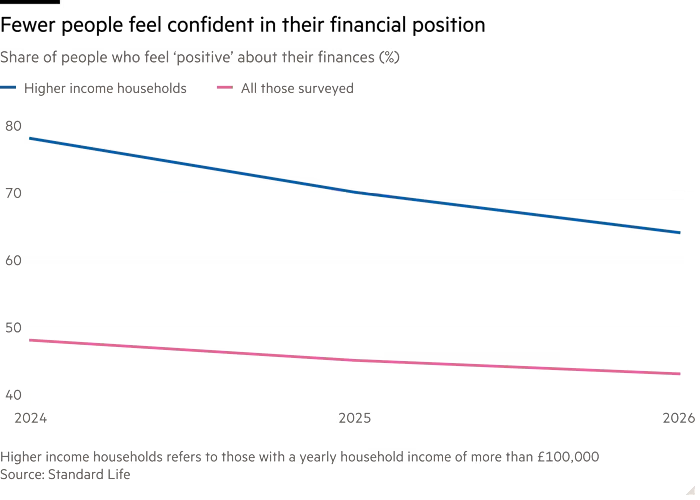
It comes as the proportion of respondents feeling “positive” about their financial situation has declined in the past three years, particularly among higher-income households, Standard Life found.
Matthew Blakstad, director of strategic policy and research at Pensions UK, said another “retirement expectation gap” is the one between the retirement that people hope for and the retirement they expect to achieve. “[This is] very real for the millions of people who are leaving the workforce in their fifties and early sixties,” he added.
Blakstad pointed to government data showing that nearly three in 10 women in this age group are economically inactive, as are more than one in five men.
“The challenge is not simply when people retire, but whether they can shape the years leading up to retirement by reducing hours, changing roles or continuing in suitable work,” Blakstad said.
Around half of the 6,000 people surveyed by Standard Life worried that their retirement finances would not last and felt that their finances were largely determined by factors outside their control.
Yet the proportion of those prioritising pension saving had fallen to 12 per cent from 15 per cent last year. More than a third had done no retirement planning at all, rising to 39 per cent of millennials and 40 per cent of Gen Z.
Those who had done “a great deal” of retirement planning had a retirement expectation gap of 2.5 years, compared with 7.3 years among those who had done none, the research found.
Among respondents in households earning more than £100,000 a year, those who had planned their retirement had a gap of less than one year, compared with around five years for those who had not.
Megan Rimmer, chartered financial planner at Quilter Cheviot, said: “Increasing pension contributions when income rises, consolidating old pension pots where appropriate, reviewing investment choices and regularly reassessing progress can all make a meaningful difference over time.
”While half of those surveyed expect they will need to work beyond the state pension age, almost one in five surveyed said they would be unable to continue in their current role past 60.
The retirement expectation gap varies across the UK and between different groups, with renters and younger generations facing some of the widest gaps, according to the research.
Wales, the East Midlands and south-east England have gaps of six years or more, with the largest gap in north-east England at 6.6 years. Greater London has the smallest retirement expectation gap at 3.8 years.
Renters face a retirement gap of 6.8 years, more than three times as large as the 2.1-year gap among those who own their home outright and just over a year longer than those with mortgages.
Rimmer said: “Some people may choose to reduce their hours or move into less demanding roles before stopping work altogether.
Others may continue working because their pension and savings are not yet able to support the lifestyle they hoped to have. The key difference is whether working longer is a positive choice or something driven by financial necessity.”
%202.png)